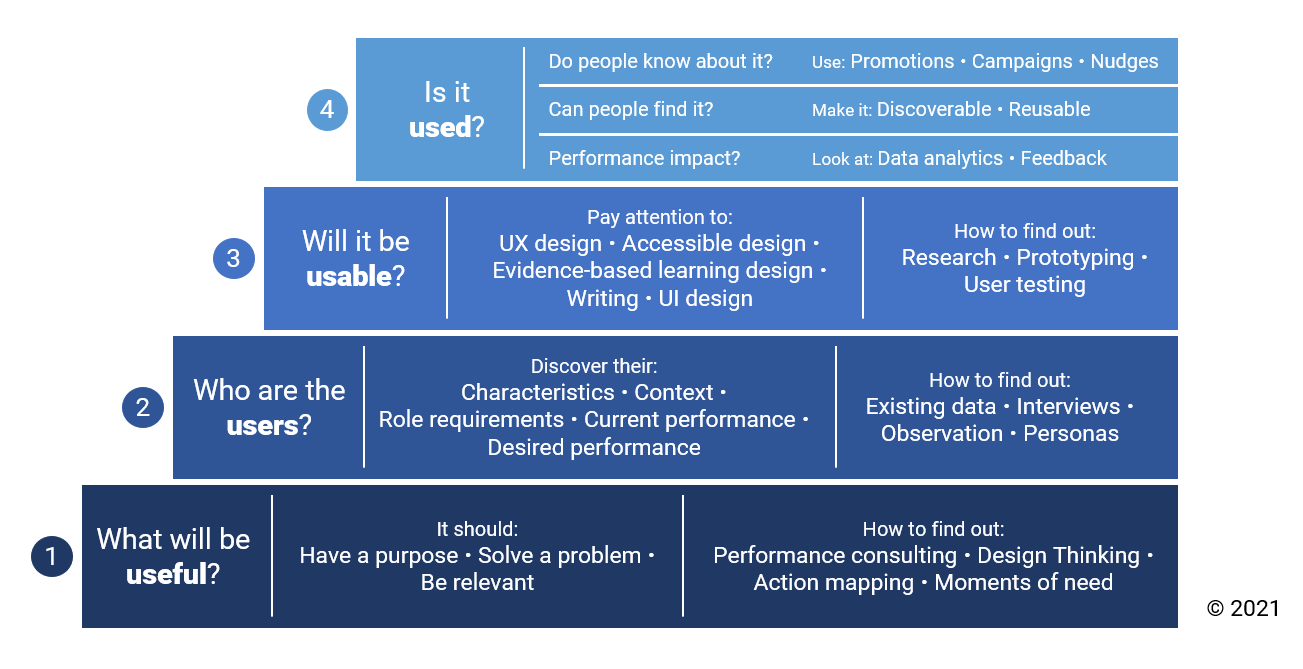
A little while ago, I created a framework for performance solutions in L&D that was built around four simple questions about the problem to be solved, the people we’re creating for, the solution itself and what happens after it’s deployed.
My intent was (and still is) to bring together a lot of good work that has been done in the L&D and other fields that will help to improve the work we do.
In thinking more about the earlier version of the framework, along with feedback from others, I’ve modified it to begin with the problem, followed by the end users, then the solution itself (whatever that might be). Again, the final step is about making it available and looking at the impact.
This is the first in a series of posts documenting how I’m applying a design thinking approach to a project I’m working on.
“Design thinking is a problem-solving methodology that focuses heavily on involving users of a solution in its design” (Boller and Fletcher, 2020).
This definition comes from the book ‘Design Thinking for Training and Development’ by Sharon Boller and Laura Fletcher. It’s the first (that I know of) that frames design thinking in the context of learning and development. It’s a valuable source of ideas and templates and if you’d like to incorporate design thinking into your projects, get your hands on a copy of this book. The overarching framework that’s used tweaks the ‘traditional’ design thinking model.
Why use a design thinking approach?
There are two things that attract me to using design thinking for L&D projects. Firstly, it’s user or human-centred, meaning that the needs of end users are the focus. The aim is to create solutions that solve a problem they are having. Some would say that this is what L&D should always be doing but sadly many learning teams are focussed on content. Secondly, solutions are developed based on research and data and in an iterative way with end users. It’s the opposite of the ‘order taking’ role that many learning departments are stuck in.
My experience with design thinking
I’ve been aware of the practice of design thinking for a few years now. I’ve read about it and watched videos on it. But knowing about something and using in the real world are two different things. For this reason, I’m a newbie to the application of design thinking tools and techniques. This project is the first time that I’ve been given the freedom and support to use an approach like this for a L&D project. I’m using the book as a guide as I move through the various stages in the approach.
The request
The initial request for this project was to improve the onboarding experience for new starters and their managers. Rather than coming up with ideas up front, the design thinking approach means to come at the project from a place of curiosity. I need to uncover the problems being experienced which will show what needs improving. This involves asking lots of questions. The one which is guiding this part of the project is: What is the current onboarding experience for new starters and managers?
Getting perspective
In the ‘traditional’ design thinking approach the first step is to empathise with end users but Boller and Fletcher refer to this as ‘getting perspective’. I like this phrasing because it emphasises finding out other points of view in order to see a bigger picture.
There are three essential questions to consider at the beginning:
What problems are we trying to solve? | What does success look like? | How will we measure success?
For this project, the answers to these will come once we have more perspective.
First steps
In my organisation, we have people spread across all areas of mainland Australia. Some of our workforce is office based, others are mostly in the field, some are a combination of these. Many people are still mostly working from home. To reach people and to find out more, I created a survey.
Now I know surveys can be problematic (this was even mentioned in the book). But I tried to minimise this by having a good mix of ‘free text’ questions where respondents can provide more detailed information. I used Microsoft Forms as the survey tool with an option for people to leave their name so that I can contact them to discuss their experience further. The purpose of these ‘interviews’ is to flesh out survey responses in more detail and help to create new starter and manager personas.
In the next post, I’ll discuss more about my approach to data gathering, conducting interviews and creating personas.
A few years ago, I wrote a blog post where I shared 5 books every eLearning professional should read. I still stand by those suggestions but I’m adding this new selection for all learning professionals. The reason I’ve selected each of these books is because they’ve contributed to the evolution of the way I work.
Here they are in no particular order:
Innovative Performance Support by Conrad Gottfredson and Bob Mosher
This book first introduced me to the five moments of learning need: New (learning something for the first time), More (expanding learning), Apply (when actually doing something), Solve (when problems arise) and Change (when learning a new way of doing something).
Gottfredson and Mosher also provide lots of ideas on performance support resources appropriate for each need. This book expanded my thinking beyond a one-size-fits-all approach and to consider different learning needs at different times.
Practice and Feedback for Deeper Learning by Patti Shank
One of the great things about Patti Shank is her evidence-based approach to learning. This book has five strategies and 26 tactics based on research that are proven to promote deeper learning and application form instruction.
Millennials, Goldfish & Other Training Misconceptions by Clark Quinn
I didn’t realise how many myths and superstitions existed within the learning field. In this book, Quinn outlines each claim as well as a counter argument (based on evidence) and what to do when you’re confronted with one of these myths and superstitions.
This is a terrific book that spans all activities and roles of modern Learning and Development teams. It covers everything from diagnosing needs, performance consulting, using data to track impact, leveraging technology, facilitation, social collaboration, curating content, coaching and supporting a more self-directed learning approach. There’s also lots of references so you can dig deeper.
This is my most recent purchase and I was keen to get my hands on a copy as soon as it came out. I only came across human-centred design or design thinking a couple of years ago. This is the first book that I know of where the techniques have been adapted and applied to creating learning experiences.
This book has clear explanations and actionable ideas that I now use to scope, design and deliver solutions to address workplace performance problems.
This is a question that you might hear in a fast food restaurant.
However, when a request for training comes to the L&D team and we provide it – we’re effectively asking the same thing.
Do we want to be thought of as the people who create training or design content? Or do we want to be known as the people who solve problems in our organisations?
If it’s the second question, then we need to really determine the problem we are trying to solve. This means starting with curiosity and not content.
Here’s some ideas about how that can happen and questions you can ask.
Look at the current state.
What’s happening now? How has the need been identified? What data is available to validate the ‘problem’?
Determine the desired future state.
What should be happening? What do people need to be able to do? What are the business goals?
The gap between the current and future states is the problem to be solved. If you define the gap now, it will help you to evaluate the effectiveness of the solution later on.
But you also need to ask some more questions.
What are the consequences of poor performance in this area? What barriers prevent the desired performance? Do any policies and/or procedures impact on performance? If so, how? What feedback or data do we have from users?
Define success.
How will you measure successful outcome(s)?
Hint: consumption of content or having knowledge isn’t success. It needs to be a measurable behavioural change or performance improvement.
The next thing is tofind out who the end users are and learn about them.
What are their characteristics, context, role? Does anyone do this well? If so, what do they do?
Create a problem statement/design challenge.
How might we help (end users) to (required behaviour/performance change) given that we know (user and gap insights).
From here, you’ll figure out the solution that will solve your problem statement. Create it. Measure and evaluate it. Make changes/improvements based on evaluation.
Obviously, this is a simplified process and not one that I’ve invented. I stand on the shoulders of giants when I say that I’ve drawn on the work of the following people in this post (click on the bold text for more):
Recently, I’ve been thinking about the work that we do within in the field of L&D. Usually, we add up all the ‘things’ we’ve produced and tell others within our organisations about all the work we’ve done. Unfortunately, many L&D teams talk in terms of outputs instead of outcomes.
But what’s the point of making more ‘things’ if they don’t make a difference in terms of performance? A big part of the problem is that the starting point and consequently the focus of our activities is on content.
There must be a better way.
In my previous two posts (One and Two) I reflected on questions that we could ask ourselves to improve the work we’re doing. Since then, I thought about how I could bring a range of techniques together to answer those questions. As a way to make sense of my thoughts, I’ve come up with a framework that, in my mind, does those things. I call it the ‘Use framework for performance solutions’ and it’s based on four simple questions.
Within each question I’ve attempted to define the components and the activities (developed by others) that will help answer the question.
Who are the Users? This question unpins the others. It’s the foundation for the work we do. How can we improve people’s performance if we don’t find out about them? What are their characteristics? What’s their context? How are they currently performing and why? What’s the desired performance?
Users also play a role in helping to answer the other questions rather than relying on subject matter experts or our own perceptions.
Is it Useful? How can we create something that will be helpful in improving performance? For something to be useful it needs to have a purpose and solve a problem for the end user. Maybe the underlying problem can’t be solved by L&D at all. It also needs to be relevant the role that the person is performing.
Is it Usable? This area takes in several others – the experience itself, the ease of use, how it’s written and that it uses evidence-based learning design.
Is it Used? How can we ensure our solutions can be found and easy to use when needed? How do we know it’s making a difference? For this section, I’ve split it into three parts. The first is making people aware of the existence of the solution including nudges when the time is right. Secondly, people need to be able to find the solution and use it when they need it. Thirdly, we need to find out the impact the solution is having. What are people doing differently now? Gathering data will inform us of the change and will tell us where improvements need to be made.
Some feedback I’ve already received suggested that the framework could be used in discussions with stakeholders – it could, I hadn’t thought of that. It’s is a work in progress so will continue to evolve. But for now it makes sense to me. What do you think?