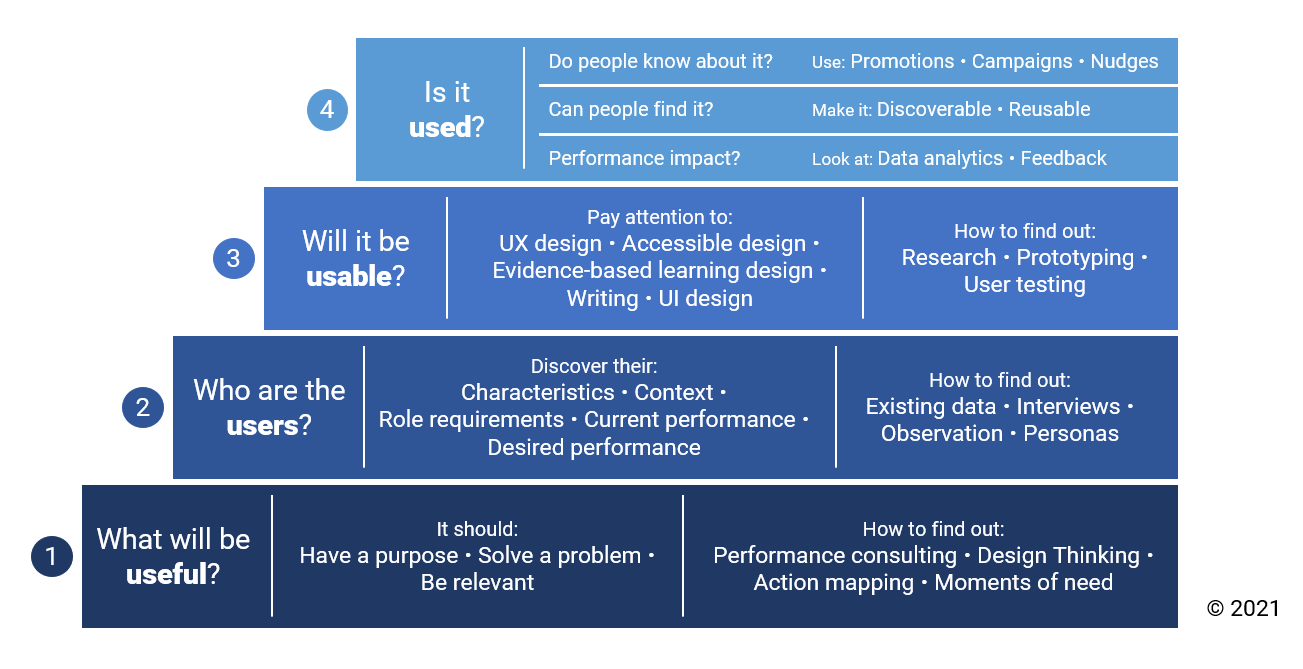
A little while ago, I created a framework for performance solutions in L&D that was built around four simple questions about the problem to be solved, the people we’re creating for, the solution itself and what happens after it’s deployed.
My intent was (and still is) to bring together a lot of good work that has been done in the L&D and other fields that will help to improve the work we do.
In thinking more about the earlier version of the framework, along with feedback from others, I’ve modified it to begin with the problem, followed by the end users, then the solution itself (whatever that might be). Again, the final step is about making it available and looking at the impact.
This is a question that you might hear in a fast food restaurant.
However, when a request for training comes to the L&D team and we provide it – we’re effectively asking the same thing.
Do we want to be thought of as the people who create training or design content? Or do we want to be known as the people who solve problems in our organisations?
If it’s the second question, then we need to really determine the problem we are trying to solve. This means starting with curiosity and not content.
Here’s some ideas about how that can happen and questions you can ask.
Look at the current state.
What’s happening now? How has the need been identified? What data is available to validate the ‘problem’?
Determine the desired future state.
What should be happening? What do people need to be able to do? What are the business goals?
The gap between the current and future states is the problem to be solved. If you define the gap now, it will help you to evaluate the effectiveness of the solution later on.
But you also need to ask some more questions.
What are the consequences of poor performance in this area? What barriers prevent the desired performance? Do any policies and/or procedures impact on performance? If so, how? What feedback or data do we have from users?
Define success.
How will you measure successful outcome(s)?
Hint: consumption of content or having knowledge isn’t success. It needs to be a measurable behavioural change or performance improvement.
The next thing is tofind out who the end users are and learn about them.
What are their characteristics, context, role? Does anyone do this well? If so, what do they do?
Create a problem statement/design challenge.
How might we help (end users) to (required behaviour/performance change) given that we know (user and gap insights).
From here, you’ll figure out the solution that will solve your problem statement. Create it. Measure and evaluate it. Make changes/improvements based on evaluation.
Obviously, this is a simplified process and not one that I’ve invented. I stand on the shoulders of giants when I say that I’ve drawn on the work of the following people in this post (click on the bold text for more):
Recently, I’ve been thinking about the work that we do within in the field of L&D. Usually, we add up all the ‘things’ we’ve produced and tell others within our organisations about all the work we’ve done. Unfortunately, many L&D teams talk in terms of outputs instead of outcomes.
But what’s the point of making more ‘things’ if they don’t make a difference in terms of performance? A big part of the problem is that the starting point and consequently the focus of our activities is on content.
There must be a better way.
In my previous two posts (One and Two) I reflected on questions that we could ask ourselves to improve the work we’re doing. Since then, I thought about how I could bring a range of techniques together to answer those questions. As a way to make sense of my thoughts, I’ve come up with a framework that, in my mind, does those things. I call it the ‘Use framework for performance solutions’ and it’s based on four simple questions.
Within each question I’ve attempted to define the components and the activities (developed by others) that will help answer the question.
Who are the Users? This question unpins the others. It’s the foundation for the work we do. How can we improve people’s performance if we don’t find out about them? What are their characteristics? What’s their context? How are they currently performing and why? What’s the desired performance?
Users also play a role in helping to answer the other questions rather than relying on subject matter experts or our own perceptions.
Is it Useful? How can we create something that will be helpful in improving performance? For something to be useful it needs to have a purpose and solve a problem for the end user. Maybe the underlying problem can’t be solved by L&D at all. It also needs to be relevant the role that the person is performing.
Is it Usable? This area takes in several others – the experience itself, the ease of use, how it’s written and that it uses evidence-based learning design.
Is it Used? How can we ensure our solutions can be found and easy to use when needed? How do we know it’s making a difference? For this section, I’ve split it into three parts. The first is making people aware of the existence of the solution including nudges when the time is right. Secondly, people need to be able to find the solution and use it when they need it. Thirdly, we need to find out the impact the solution is having. What are people doing differently now? Gathering data will inform us of the change and will tell us where improvements need to be made.
Some feedback I’ve already received suggested that the framework could be used in discussions with stakeholders – it could, I hadn’t thought of that. It’s is a work in progress so will continue to evolve. But for now it makes sense to me. What do you think?
Not long after publishing my previous post Three ‘Use’ words for L&D, it occurred to me that while these words relate to the learning solutions itself, there’s a fourth ‘use’ word that I neglected to include.
User.
It’s by understanding the context of the user that we can create something useful. Something that has a purpose and solves a problem for them.
It’s by testing with users that we can determine the usability (and make changes from feedback). We can discover if it can be located when needed and if it’s uncomplicated to use.
It’s by collecting and analysing data that we can find out how the solutions are (or are not) being used. Again, making changes where needed. More importantly, we need to measure whether we’ve achieved our intended goal.
For much of my career I’ve been involved in creating “solutions” for end users while working at a distance from them. In recent times, I’ve come to realise that there’s much more value involving end users to create real solutions that they need instead of thinking that we know what’s good for them.
I’m currently completing an online course on Human-Computer Interaction (HCI) via the Interaction Design Foundation. In one lesson, Prof Alan Dix talks about three ‘use’ words within the design side of HCI. It got me thinking that these three words could also apply to learning and development.
If we are to make a difference in our organisations, we need to design and create solutions that are:
Useful
It helps people do something they need to do, when they need to do it. It’s functional and serves a purpose. It produces results for the user and ultimately the organisation.
Ask yourself: Does it have a purpose?Does it solve a problem?
Usable
It’s readily
available and conveniently located for easy access when required. It doesn’t add
complexity or create confusion for the user.
Ask yourself: Can it be found easily?Is it straightforward to use?
Used
If our solutions are useful and usable, it’s highly likely that they’ll be used. After all, if nobody uses it, then what was the point of the time and effort employed in designing and creating it in the first place?