Tag: performance support

  • The Use Framework revisited

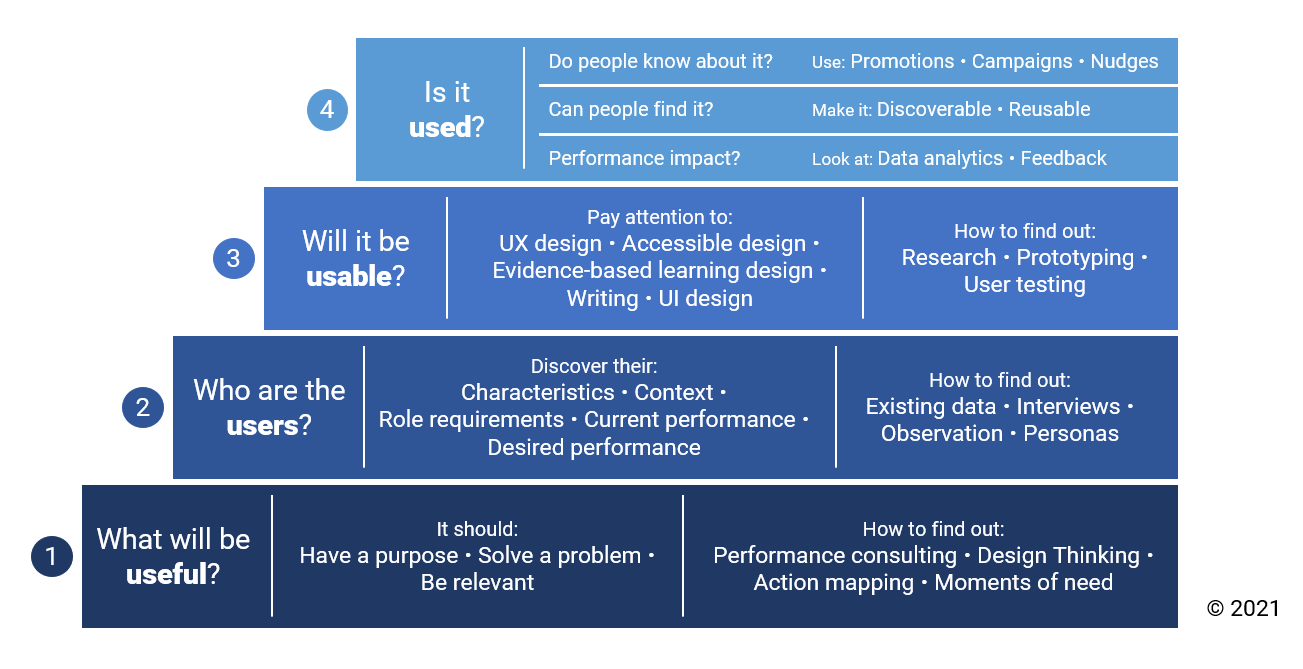
    A little while ago, I created a framework for performance solutions in L&D that was built around four simple questions about the problem to be solved, the people we’re creating for, the solution itself and what happens after it’s deployed.

    My intent was (and still is) to bring together a lot of good work that has been done in the L&D and other fields that will help to improve the work we do.

    In thinking more about the earlier version of the framework, along with feedback from others, I’ve modified it to begin with the problem, followed by the end users, then the solution itself (whatever that might be). Again, the final step is about making it available and looking at the impact.

    What have I missed? What else could be added?

  • 5 books for all learning professionals

    A few years ago, I wrote a blog post where I shared 5 books every eLearning professional should read. I still stand by those suggestions but I’m adding this new selection for all learning professionals. The reason I’ve selected each of these books is because they’ve contributed to the evolution of the way I work.

    Here they are in no particular order:

    Innovative Performance Support by Conrad Gottfredson and Bob Mosher

    This book first introduced me to the five moments of learning need: New (learning something for the first time), More (expanding learning), Apply (when actually doing something), Solve (when problems arise) and Change (when learning a new way of doing something).

    Gottfredson and Mosher also provide lots of ideas on performance support resources appropriate for each need. This book expanded my thinking beyond a one-size-fits-all approach and to consider different learning needs at different times.

    Practice and Feedback for Deeper Learning by Patti Shank

    One of the great things about Patti Shank is her evidence-based approach to learning. This book has five strategies and 26 tactics based on research that are proven to promote deeper learning and application form instruction.

    Millennials, Goldfish & Other Training Misconceptions by Clark Quinn

    I didn’t realise how many myths and superstitions existed within the learning field. In this book, Quinn outlines each claim as well as a counter argument (based on evidence) and what to do when you’re confronted with one of these myths and superstitions.

    Driving Performance Through Learning by Andy Lancaster

    This is a terrific book that spans all activities and roles of modern Learning and Development teams. It covers everything from diagnosing needs, performance consulting, using data to track impact, leveraging technology, facilitation, social collaboration, curating content, coaching and supporting a more self-directed learning approach. There’s also lots of references so you can dig deeper.

    Design Thinking for Training and Development by Sharon Boller and Laura Fletcher

    This is my most recent purchase and I was keen to get my hands on a copy as soon as it came out. I only came across human-centred design or design thinking a couple of years ago. This is the first book that I know of where the techniques have been adapted and applied to creating learning experiences.

    This book has clear explanations and actionable ideas that I now use to scope, design and deliver solutions to address workplace performance problems.
  • At the coalface

    I’ve said before that the role of learning and development is to support the people in our organisations who do the actual work. This isn’t to dismiss our work as unimportant but:

    We’re not on the phones speaking to clients.

    We’re not working outside in all weather conditions.

    We’re not growing the number of new customers to our business.

    We’re not on the production line in a factory.

    However, we’re attempting to create learning experiences and support tools for them. Our goal is to improve their performance, but we often don’t understand what their job is like because we work at a distance from them. At the security of our desks. Behind our computers.

    Working in an L&D team within an organisation presents an opportunity for us to find out more about what our end users do. More importantly, how they do it in the context of their day-to-day.

    Let’s step away from our desks and spend some time with those at the coalface. If we invest our time with the people in our organisations, we might better understand how effective our ‘solutions’ really are.

    Image source: Morguefile.com
  • Happy New Year!

    Another year begins.

    A fresh start.

    A new page.

    I’ve always liked this time of year because it feels like so much is possible. Looking back and last year is done and like the years before we can’t change what has happened. The past is in the past as they say. But this year is just getting started and I’m feeling optimistic about the coming year because to a large extent what I want the year to be is up to me.

    Last year was a quiet one for me on the blogging and sharing front (I’m feeling rusty writing this post). This was partly due to having a young child which brings about a shift in priorities in a good way. The need for sleep becomes way more important. Despite this, I tried to stay in touch with the happenings in the learning field when I could by reading articles/posts and listening to podcasts here and there. There still seems to be a lot of people talking about what L&D needs to do, with far fewer sharing the how.

    My other reason for less blogging was that I felt flat, lacked motivation and that I’d lost my purpose for writing. I was tired of the constant content focus in learning – the course as the default. I was tired of creating eLearning content dumps where more meaningless interactivity was the goal. Unfortunately, the content design approach is still widespread and as a result we’ve conditioned stakeholders, SME’s, clients and decision makers that this is what we do. The people that suffer are those taking the modules.

    I’ve said before that our role is to support the people in our organisations who do the actual work. Working in learning presents an opportunity to get closer to our organisations and find out what people do, how they do it and what their challenges are. Then we’ll be better placed to offer solutions and experiences that have real impact rather than focusing on the number of objects we produce.

    Nothing will change if we keep doing the same thing. So that’s my goal for this year, to do things differently, evolve my practice and to reflect and share via this blog.

    Happy 2019!

    Image source: Canva
  • Learning and Development: You Have One Job

    In many organisations, the learning and development (L&D) area are known as the people who deliver information – mostly via courses – either online or in a classroom. Many of which are essentially nothing more than one-off, content dumps.

    We say that we want to be business partners and express our desire for a seat at the table so we talk about “capacity building”, “a learning organisation” and “ecosystems” in an attempt to achieve this.

    We talk about blending, flipping, shrinking, socialising and gamifying learning events but often the execution has the wrong focus.

    We’ve become overly fixated on frameworks and models and waste time debating their proportions instead of using them as a guide and not a prescription.

    We cling to concepts that don’t exist yet dismiss others despite the evidence from research that exists.

    However, the role of everyone working in learning and development is simple:

    To support the people in our organisations who do the actual work.

    We’re not operating machines, or digging trenches, or serving customers in shops or on the phone, or treating patients or selling widgets. We’re not working outside in the elements. We’re not (usually) working night shift or on the weekend. But the people in our organisations are and we must ensure they can perform whenever and wherever they are working.

    I’ve been reading Innovative Performance Support by Conrad Gottfredson and Bob Mosher and they refer to the ‘Five Moments of Learning Need’ (p37-38):

    New: when people are learning how to do something for the first time.

    More: when people are expanding on what they have learned.

    Apply: when people need to plan what they need to do, remember what they may have forgotten or adapt their performance to a unique situation.

    Solve: when people need to deal with problems, something breaks or doesn’t work as intended.

    Change: When people need to learn a new way of doing things that requires them to change ingrained skills.

    My takeaway is that different moments of need require different solutions and the current one size, one event fits all approach is not effective. So, before we launch yet another information overloaded course, we should ask ourselves a question – is this really supporting our people to do the work they need to do?

    Image source: Morguefile