Tag: learning design

  • The Use Framework revisited

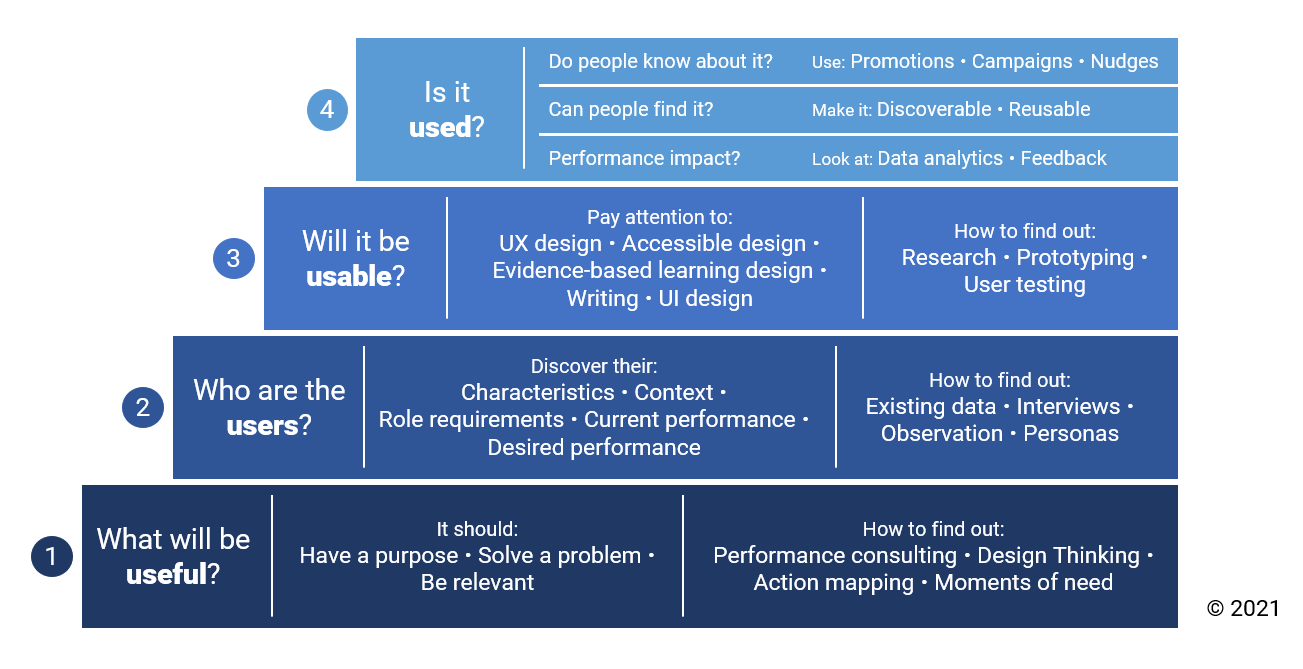
    A little while ago, I created a framework for performance solutions in L&D that was built around four simple questions about the problem to be solved, the people we’re creating for, the solution itself and what happens after it’s deployed.

    My intent was (and still is) to bring together a lot of good work that has been done in the L&D and other fields that will help to improve the work we do.

    In thinking more about the earlier version of the framework, along with feedback from others, I’ve modified it to begin with the problem, followed by the end users, then the solution itself (whatever that might be). Again, the final step is about making it available and looking at the impact.

    What have I missed? What else could be added?

  • The Use Framework for performance solutions

    Recently, I’ve been thinking about the work that we do within in the field of L&D. Usually, we add up all the ‘things’ we’ve produced and tell others within our organisations about all the work we’ve done. Unfortunately, many L&D teams talk in terms of outputs instead of outcomes.

    But what’s the point of making more ‘things’ if they don’t make a difference in terms of performance? A big part of the problem is that the starting point and consequently the focus of our activities is on content.

    There must be a better way.

    In my previous two posts (One and Two) I reflected on questions that we could ask ourselves to improve the work we’re doing. Since then, I thought about how I could bring a range of techniques together to answer those questions. As a way to make sense of my thoughts, I’ve come up with a framework that, in my mind, does those things. I call it the ‘Use framework for performance solutions’ and it’s based on four simple questions.

    Within each question I’ve attempted to define the components and the activities (developed by others) that will help answer the question.

    Who are the Users?
    This question unpins the others. It’s the foundation for the work we do. How can we improve people’s performance if we don’t find out about them? What are their characteristics? What’s their context? How are they currently performing and why? What’s the desired performance?

    Users also play a role in helping to answer the other questions rather than relying on subject matter experts or our own perceptions.

    Is it Useful?
    How can we create something that will be helpful in improving performance? For something to be useful it needs to have a purpose and solve a problem for the end user. Maybe the underlying problem can’t be solved by L&D at all. It also needs to be relevant the role that the person is performing.

    Is it Usable?
    This area takes in several others – the experience itself, the ease of use, how it’s written and that it uses evidence-based learning design.

    Is it Used?
    How can we ensure our solutions can be found and easy to use when needed? How do we know it’s making a difference? For this section, I’ve split it into three parts. The first is making people aware of the existence of the solution including nudges when the time is right. Secondly, people need to be able to find the solution and use it when they need it. Thirdly, we need to find out the impact the solution is having. What are people doing differently now? Gathering data will inform us of the change and will tell us where improvements need to be made.

    Some feedback I’ve already received suggested that the framework could be used in discussions with stakeholders – it could, I hadn’t thought of that. It’s is a work in progress so will continue to evolve. But for now it makes sense to me. What do you think?

  • One more ‘Use’ word for L&D

    Not long after publishing my previous post Three ‘Use’ words for L&D, it occurred to me that while these words relate to the learning solutions itself, there’s a fourth ‘use’ word that I neglected to include.

    User.

    It’s by understanding the context of the user that we can create something useful. Something that has a purpose and solves a problem for them.

    It’s by testing with users that we can determine the usability (and make changes from feedback). We can discover if it can be located when needed and if it’s uncomplicated to use.

    It’s by collecting and analysing data that we can find out how the solutions are (or are not) being used. Again, making changes where needed. More importantly, we need to measure whether we’ve achieved our intended goal.

    For much of my career I’ve been involved in creating “solutions” for end users while working at a distance from them. In recent times, I’ve come to realise that there’s much more value involving end users to create real solutions that they need instead of thinking that we know what’s good for them.

    Image by Engin Akyurt from Pixabay
  • Three ‘Use’ words for L&D

    I’m currently completing an online course on Human-Computer Interaction (HCI) via the Interaction Design Foundation. In one lesson, Prof Alan Dix talks about three ‘use’ words within the design side of HCI. It got me thinking that these three words could also apply to learning and development.

    If we are to make a difference in our organisations, we need to design and create solutions that are:

    Useful

    It helps people do something they need to do, when they need to do it. It’s functional and serves a purpose. It produces results for the user and ultimately the organisation.

    Ask yourself: Does it have a purpose? Does it solve a problem?

    Usable

    It’s readily available and conveniently located for easy access when required. It doesn’t add complexity or create confusion for the user.

    Ask yourself: Can it be found easily? Is it straightforward to use?

    Used

    If our solutions are useful and usable, it’s highly likely that they’ll be used. After all, if nobody uses it, then what was the point of the time and effort employed in designing and creating it in the first place?

    Image source: Morguefile.com
  • Response from an eLearning Creator

    Dear Engaged Learner,

    Thank-you for your letter and my apologies for the delay in replying. I receive so many from engaged learners like you that it takes me a little while to respond but it always warms the cockles of my heart to read them.

    I’m so pleased to read that you were engaged during the course but I honestly can’t take all the credit. You see, my colleagues and I usually receive a request for some training when there’s a real or imagined issue or when the legal or safety teams say it needs to be done. We don’t dig to deeply to find out more because it’s always a knowledge gap and creating courses full of information is always the most effective solution. Plus, it’s what we’re known for! Our motto here in the creation team is “if we build it, they will learn”.

    When I develop a course, I work with people who have expertise in the field called subject matter experts (or SME for short and is pronounced smee). But they are so much more than that as they are usually experienced writers, graphic designers, assessors and learning theorists. Even though I have many years of experience, multiple degrees and diplomas in Adult Education and Multimedia and Educational Psychology, write for numerous online publications and actively participate in the eLearning community I still don’t know as much as they do about online learning. They’re so amazing! The SME’s also like to change their minds a lot and they always want to add just a little more content to the course which is quite ok with me because they know best and it always makes the courses better.

    The Communications and Marketing area also deserve a pat on the back for supplying us with the 153-page branding guideline document that spells out the exact colours and fonts to be used as well as the layout and crucial logo information (size, position and inclusion throughout). These things make such a significant contribution to learning but more importantly, it makes the courses look like everything else that’s produced by every other department in the organisation. This will ensure we don’t cause panic among people who won’t know where they are or who produced the course and also keeps them engaged.

    Even though most people use computers and the internet for work and at home and have done for many years without instruction they may not know how to navigate through our courses. Which is why we include the navigation help in every course (even if they are the same). Also, having people think for themselves in online learning is dangerous so it’s much easier if they are always controlled which is why I don’t let people skip anything. As you mentioned, you didn’t want to miss anything which is great because you need to read all of it to learn.

    I’m happy that you liked how I jazzed up the course as the content was dull so it seems like I was able to engage you and at the same time show you how clever I am. There is some well-known and much-loved “science” behind it though. The use of audio to read screen text, images on every screen and lots of clicking, dragging and hovering is because I’m catering for different learning styles, such as seers and listeners and touchies. There’s over 70 learning style models that we use and we manage to have something in there for all of them! This helps people to learn much more effectively and guides many creators here and around the world to produce engaging learning experiences.

    I’m so glad that you enjoyed the game show knowledge check! For the next module (and please keep this a secret) you’ll be a knight that goes on a quest. Along the way you’ll come across a series of dragons who’ll ask you questions and if you choose the right answer you’ll slay the dragon! It’s going to be so much fun and so engaging. You’ll be able to print a certificate for this one to add to your collection. I often look fondly on the ones I’ve accumulated over the years.

    Well, while I may never meet you, I’m easy to find. Just look for the tower made from the finest ivory and that’s where I’ll be along with the rest of the learning and development team working on our next engaging course so that people will know more stuff.

    Signed,
    The Senior Head Specialist Consulting Advisor in Instructional Learning Architecture Design and Creator of Engaging Knowledge Development Solutions for Organisational Capability.

    Image source: morgueFile.com